Practical tips for advanced German-learners after reaching fluency
It’s common knowledge that any skill can only be learned with practice and discipline. This definitely applies to learning languages but unfortunately learning a new language as an adult comes with an obvious hurdle — one would never reach a level similar to native speakers. So even after reaching an advanced level like C1 or C2, there will always be a language gap between native and non-native speakers. This is not a reason to simply give up and stop trying to reduce this gap as much as possible. The goal of this article is to introduce some practical tips that can be used to improve German language skills and take them beyond the advanced level.
Collocations
Since you already have a profound understanding of German grammar rules, now it’s time to forget about the grammar and focus on common reusable sentences. What I mean by this is to start to have a sense for words that are most likely to come together in a phrase. Such words and their relationship are called collocations. For example it’s common to say “eine Familie gründen” instead of “eine Familie starten” — although both can give the same meaning, a German native speaker would never use the verb “starten” in this context. On the contrary, an English native speaker is most likely to use “starten” since in English it’s called “to start a family”.
There are books that can help systematically learn the most common collocations in German. One that I would like to recommend is “Feste Wortverbindungen des Deutschen”. There are three freely available chapters from this book online and they can be downloaded from this website.
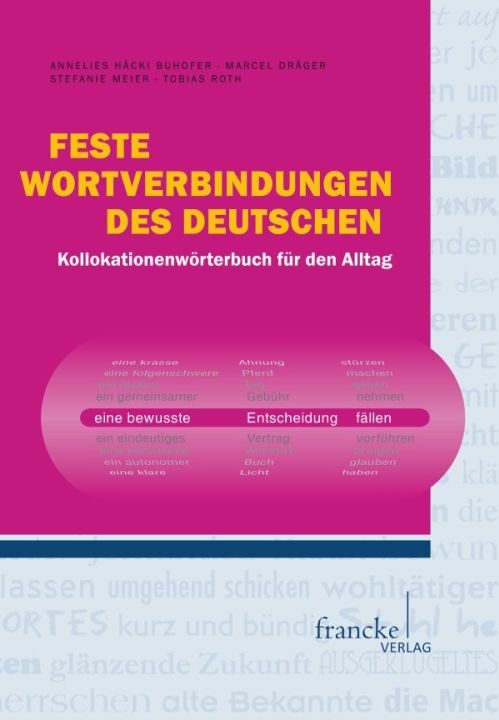
"Feste Wortverbindungen des Deutschen"
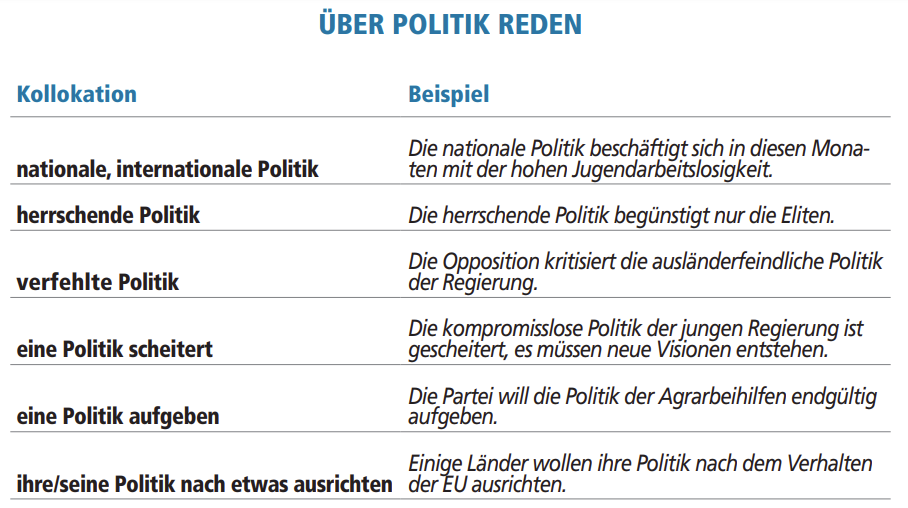
Example collocations from the book. Source: kollokationenwoerterbuch.ch
“Da fehlen mir die Worte” is another book that has a lot of advanced exercises targeting serious learners. This book tackles synonyms, antonyms, collocations and idioms. After finishing this book you will have a good understanding of the things that you can do to further improve your language skills.
Idioms / Expressions
Mastering special expressions and idioms can give the impression of profound language skills — and sometimes you might even be able to impress others with idioms that no one knows! Which is a lot of fun!
There is no practical solution to learning idioms other than simply memorizing them by heart. Luckily there are websites that can be very helpful:
- www.redensarten-index.de — an extensive collection of idioms with a very good searching system
- www.redensarten.net — categorizes idioms, making it easy to learn for a specific goal
Succinct German!
I’m sure you already know how to properly build a sentence in German and you can easily apply grammar rules and even correct written text. But what you may have noticed is that not all native speakers hold on to these rules — in fact they even break them regularly. This has to do with how languages develop and you can also participate in this development!
By breaking some rules, especially whilst speaking, you can sound more native and show a deeper understanding of colloquial German. As an example, let’s take this simple phrase: “Danke, ich habe es schon bekommen”. Everything here is fine and elegant, but the fact is that you may rarely hear it formulated in this way. Native speakers would most likely say “Danke, hab schon” — dropping the personal pronoun “Ich” and the letter e from “habe” (which is very common).
The idea is that by imitating/learning these small things you achieve better fluency and can further understand colloquial German. A nice article about German colloquial expressions can be found here.
Fügewörter / Partikeln
Almost all languages have what I call “dressing words” — such words do not have any purpose other than giving phrases more taste. We don’t need them to form a correct sentence but nonetheless they do play a role in communication. The German language has a lot of them and native speakers love to use them all the time!
Therefore it’s wise to learn them and start “dressing” your phrases with them. You can further read about this topic here.
Keep Learning!
Reaching fluency shouldn’t mean that the learning process has stopped. You can always learn something new in the language and it doesn’t have to take a lot of your time. Here are a couple of small things you can do on a daily basis to keep learning:
- When you think you are making mistakes or when you feel unable to correctly express an idea, write it down in your native language so you can later translate it to German and search online for the correct way of saying it. Gradually, you will start noticing that the amount of such expressions is getting lower — an indication of improvement.
- Integrate reading German into your daily routine and write new words/expressions on a side list so you can review them after a while.
- Ask questions! People generally like to correct language mistakes but might hesitate doing so to not hurt your feelings. If you are unsure of the correct word or expression, simply ask a native speaker for help. It takes no time and gives the feeling of value and importance to the helping side — a win-win situation.
Have Fun and Enjoy the Language!
Don’t let grammar police bother you. Enjoy your mistakes, notice them and then change them. Ask people to correct you — especially if it’s a common mistake that you keep making. If people laugh at your mistakes, don’t take it personally; you also find it funny when foreigners make mistakes learning your native language. Just laugh with them and enjoy their enjoyment. Let go of your ego!
In fact, I’ll go further and say that you have a privilege as a non-native speaker: you can make as many mistakes as you want and no one will be bothered or try to blame you for it. Whereas a native speaker is judged by every word.
Be Linguistically Liberal!
Let’s look pragmatically at any language and ask the simple question: what is a language? A language is simply a tool used for communication. So the goal of learning and perfecting any language is being able to effectively communicate ideas and emotions. If you can achieve this without holding onto some set of written rules, then you simply don’t need these rules!
Use your imagination and create your own words/phrases that can carry meaning — words that might even be missing from Duden! Let me give you an example: the word “irgendwarum” doesn’t really exist in German but nonetheless it carries the meaning of “aus irgendwelchem Grund” and many learners come up with it on their own (just google it). This makes sense, since such a word exists in most other languages. If you tell anyone this word they might find it very funny and weird, but they will totally understand what you mean. Coming up with new words intuitively is also a good sign that your brain has started to notice the patterns of the German language.
Don’t hesitate to translate from your native language, even if you are sure that you will come up with words or phrases that aren’t conform to German. It’s about communication and not blindly following rules and collocations.